
Logistics Control Tower ROI: Key Metrics, Benefits, and Implementation Timeline

Key Highlights
- Companies with true supply chain control towers report logistics cost reductions of 3-5% and inventory reductions of 5-15%.
- AI-enabled control tower use cases have delivered 5-20% logistics cost reductions in distribution operations.
- Cloud-native control towers typically reach measurable ROI within 6-18 months of going live.
- India's logistics cost is now assessed at between 7.8% and 8.9% of GDP, raising the bar for supply chain visibility and efficiency.
Logistics control tower ROI is the measurable return an organization gets from centralizing shipment visibility, exception handling, and cross-partner coordination into a single decision layer, expressed in cost reduction, inventory efficiency, and labor productivity, not just dashboard adoption. A control tower earns its budget when it changes how fast a team responds to a delay or disruption, not when it simply displays more data than before. That distinction matters because most of the reported value comes from what the control tower lets a team do with visibility, not the visibility itself.
What Does Logistics Control Tower ROI Actually Measure?

ROI for a control tower is measured against the specific operational decisions it speeds up or improves, not against a generic "visibility" outcome. The clearest way to evaluate it is to separate three categories: cost impact (freight, inventory, labor), service impact (on-time delivery, fill rate), and resilience impact (time to detect and respond to disruption). A control tower that only shows a shipment is late, without changing how quickly someone acts on that information, produces dashboard adoption but not ROI.
This is a documented gap in the industry: most control tower rollouts stop at the dashboard layer, showing that a shipment is late without automating or accelerating the decision that follows. The ROI case has to be built around closing that gap, not just adding a screen.
The Core Benefits Driving Control Tower ROI
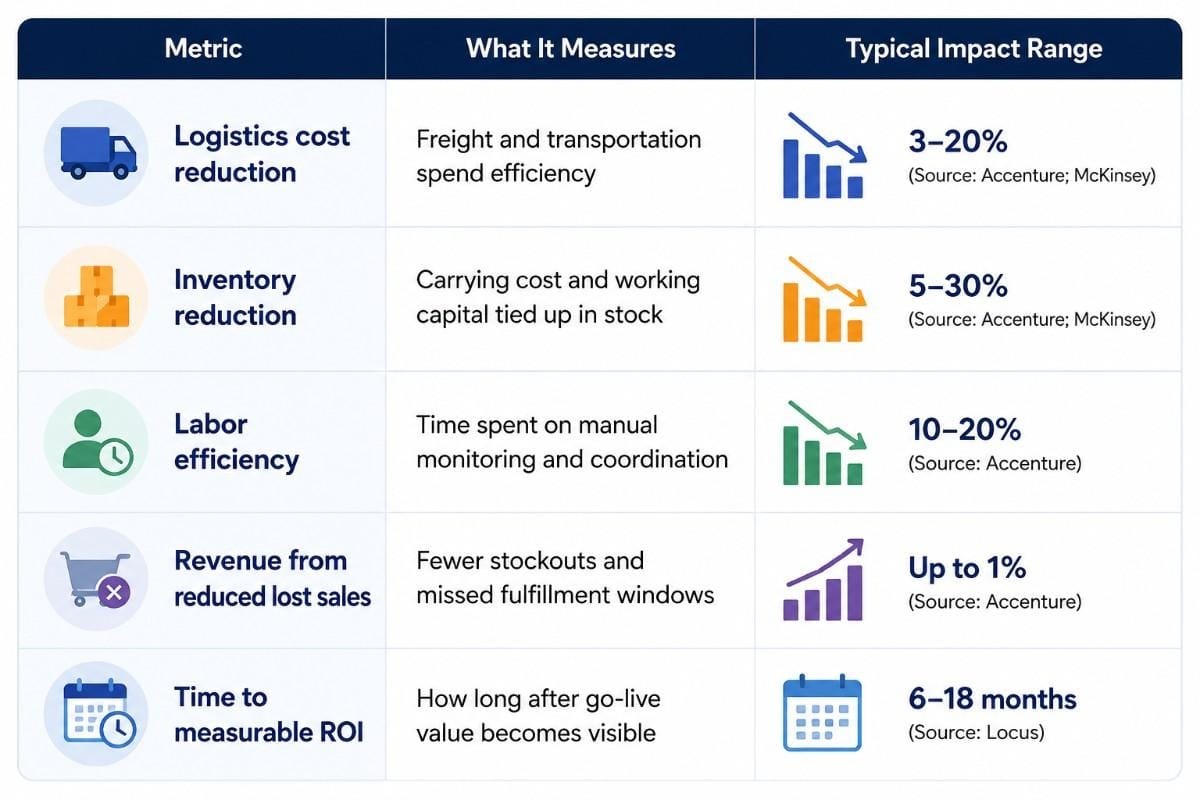
The benefits that actually move the ROI needle cluster around cost, inventory, and labor efficiency rather than visibility alone. Companies that have implemented true supply chain control towers report logistics cost reductions of 3-5%, labor efficiency improvements of 10-20%, inventory reductions of 5-15%, and up to 1% revenue growth from reduced lost sales. Separately, McKinsey's research on AI-enabled distribution operations found logistics cost reductions of 5-20%, inventory reductions of 20-30%, and procurement spend reductions of 5-15% where control tower use cases were embedded into daily workflow.
Exception management means the system automatically flags shipments, orders, or inventory positions that deviate from the plan, a missed pickup window, a stockout risk, or a delayed delivery, so a team can act on the exception instead of manually checking every shipment to find it.
Which Key Metrics Should You Track After Going Live?

The metrics that matter after go-live are the ones tied directly to decision speed, not general activity on the platform. Track on-time delivery rate, cost per delivery, inventory carrying cost, and time-to-detect-and-resolve an exception; these reflect whether the control tower is shortening the gap between a problem and an action. Beyond visibility, RoaDo extends ROI into freight finance by automating invoice audits to recover the 1-5% of spend typically lost to carrier billing errors. Exception-alert volume is a particularly useful early metric since it shows whether the system is surfacing real, actionable issues rather than noise; RoaDo's AI-based exception alerts, for instance, have helped its customers avoid over 1 lakh delays across the shipments it tracks, which is the kind of trackable, decision-linked metric a control tower business case should be built on.
Logistics Control Tower ROI Metrics at a Glance
Control Tower Implementation Timeline: What to Expect
Implementation timelines for control towers vary significantly depending on whether you're buying a pre-built platform or building a custom one, and that choice is the single biggest driver of how quickly ROI is realized. Commercial, pre-built control towers offer faster implementation and vendor expertise, while custom-built platforms provide more flexibility but require substantially more time and internal resources. Traditional, heavily customized control tower deployments can take months to years to show measurable value because of the system integration work involved, while lighter, workflow-automation-focused platforms designed to plug into existing systems can deliver measurable impact within the first year.
The timeline difference isn't about vendor quality; it's about how much of your existing tech stack (TMS, WMS, and ERP) the control tower has to be custom-integrated with before it can start surfacing usable exceptions.
Getting Control Tower Value Without a Multi-Year Rollout
For manufacturers in India managing freight through a mix of small transporters and third-party fleets, a full enterprise control tower rollout often isn't the realistic starting point; the cost and integration timeline don't match the scale of the operation. India's logistics cost, now estimated in the 7.8-8.9% GDP range, reflects an environment where fragmented visibility across small carriers is still a structural cost driver, which is exactly the gap a control tower is meant to close.
This is where a modular, zero-CAPEX platform positioned as a logistics operating system, RoaDo, for example, becomes a practical entry point rather than a scaled-down compromise. Instead of a multi-year systems integration project, this category of platform layers exception management and shipment visibility on top of existing operations without requiring GPS hardware or a full ERP replacement; by integrating directly with India’s VAHAN and GSTN portals, RoaDo provides a working version of control-tower-style decision support within weeks rather than years. Platforms like this are built for exactly this kind of incremental, budget-conscious path to visibility.
Frequently Asked Questions
1. What is a logistics control tower?
A logistics control tower is a centralized system that provides real-time visibility across shipments, inventory, and partners to support faster, more coordinated decision-making.
2. How is ROI measured for a logistics control tower?
ROI is measured through metrics like logistics cost reduction, inventory efficiency, labor productivity, and time-to-resolve exceptions, rather than dashboard usage alone.
3. How long does it take to implement a control tower?
Pre-built, cloud-native control towers can show measurable ROI within 6–18 months, while custom-built or heavily integrated systems can take significantly longer.
4. What is the difference between a control tower and a TMS?
A TMS manages transportation execution specifically, while a control tower provides broader, cross-functional visibility across transportation, inventory, and partner networks.
5. Can small and mid-sized manufacturers benefit from a control tower?
Yes, modular, lighter-weight platforms now bring exception management and visibility benefits to smaller operations without requiring an enterprise-scale rollout.
6. What metrics should be tracked after control tower go-live?
On-time delivery rate, cost per delivery, inventory carrying cost, and time-to-resolve exceptions are the core metrics to track.
7. Does a control tower replace an ERP system?
No, a control tower typically integrates with an existing ERP rather than replacing it, adding a visibility and decision-support layer on top.
8. What is the biggest risk in control tower implementation?
The biggest risk is stopping at the dashboard layer , building visibility without connecting it to faster, automated decision-making.
Conclusion
Logistics control tower ROI depends less on how much data a dashboard displays and more on whether that visibility actually shortens the time between a problem occurring and a team acting on it.
The documented benefits, cost reductions in the mid-single digits to low double digits, inventory efficiency gains, and faster exception resolution are consistent across enterprise research, but they only materialize when the implementation approach matches the organization's scale and integration capacity.
A multi-year, fully customized rollout makes sense for some enterprises, while a modular, faster-deploying platform makes control-tower-style benefits accessible to manufacturers who can't justify that timeline. Platforms like RoaDo are built for exactly this kind of incremental path, bringing exception management and shipment visibility into reach without a multi-year systems project. As logistics cost pressure continues to reward organizations with real-time visibility, the choice increasingly isn't whether to invest in this kind of coordination but how quickly a given implementation model gets you there.
“Maximize logistics ROI with RoaDo's AI-powered logistics operating system. Gain real-time visibility, automate exception management, and improve supply chain performance. Contact RoaDo today."