
Freight Audit Checklist: How to Catch Billing Errors and Overcharges Before You Pay
Key Highlights
- Industry studies estimate 5% to 15% of freight invoices contain errors, most favoring the carrier.
- A typical freight audit recovers 1% to 5% of total freight spend once a systematic review is in place.
- LTL shipments carry the highest error rate, with weight and class disputes causing 5-25% invoice variance.
- A mismatch between an invoice and its e-way bill can trigger detention and penalties under Section 129 of the CGST Act.
Using a freight audit checklist is a critical process for checking every freight invoice against the agreed contract rate, the actual shipment details, and applicable charges before payment goes out. It's not a once-a-year finance exercise; it's a line-item review that catches the gap between what a carrier billed and what was actually owed. For most shippers, that gap is bigger and more frequent than they assume.
What a Freight Audit Actually Catches
A freight audit exists to catch the difference between the invoice amount and the amount actually owed under the contract before that difference becomes a payment. This covers base freight rates, fuel surcharges, accessorial fees, weight and dimension charges, and duplicate billing. The audit isn't assuming fraud; most errors come from outdated rate tables, manual data entry, or mismatched systems between shipper and carrier, not deliberate overbilling.
Industry estimates put the scale of the problem at 5% to 15% of freight invoices containing some kind of error, with the majority favoring the carrier rather than the shipper. Separately, research cited by Hyland found that as many as 80% of carrier invoices contain some kind of discrepancy, with 15-20% of those discrepancies being outright overcharges averaging 8-10% above the correct amount. Even taking the more conservative end of these ranges, a business processing hundreds of freight invoices a month is very likely absorbing costs it doesn't owe.
Why Are Freight Invoices Riddled With Errors?
Freight invoices go wrong because carrier billing systems don't automatically stay in sync with your negotiated contract. When a rate is renegotiated, the carrier's internal rate table doesn't always get updated on the same timeline, and the invoice that comes out is billed against the old, higher rate. Add nonstandardized invoice formats, where one carrier's "notify fee" is another's "call before delivery" charge, and manual review becomes a translation problem before it's even a math problem.
An accessorial charge is any add-on fee beyond the base freight rate, liftgate service, detention, residential delivery, or inside pickup, and it's consistently the highest-error category on freight invoices because it's often applied automatically without verification that the underlying condition actually occurred.
The Freight Audit Checklist: Line Items to Check Before You Pay
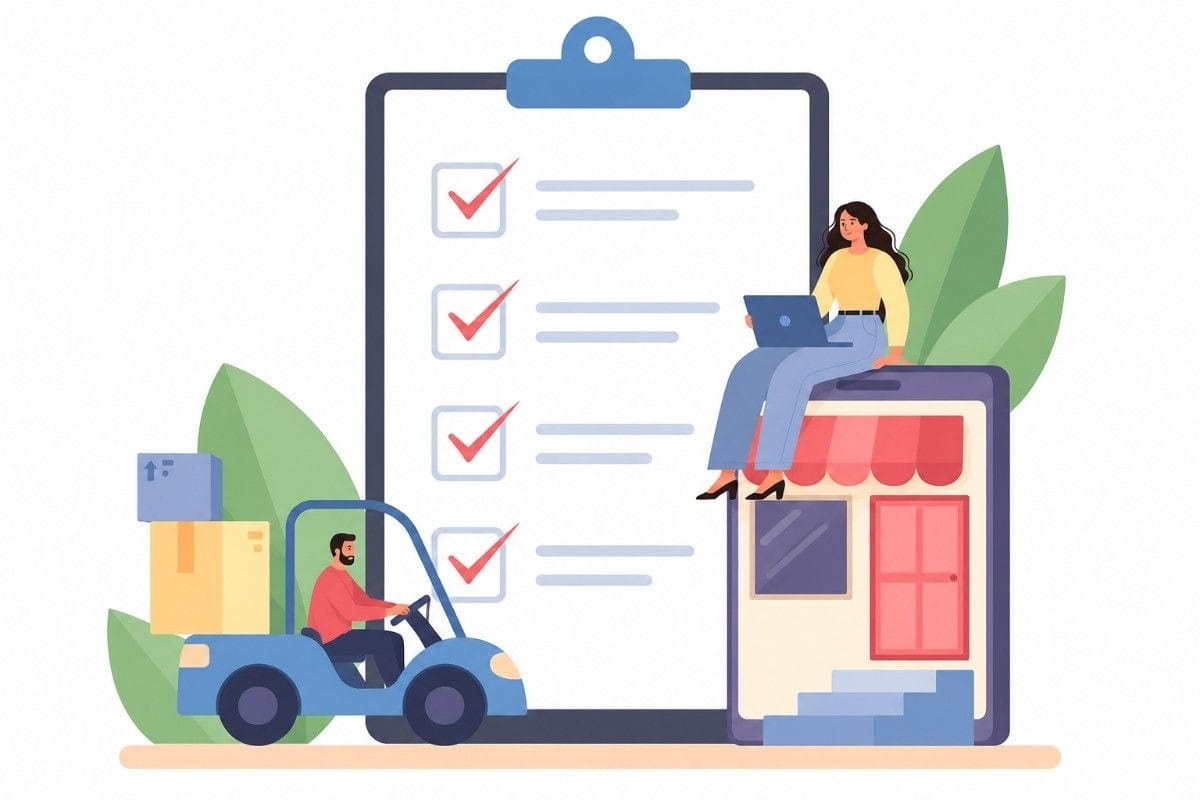
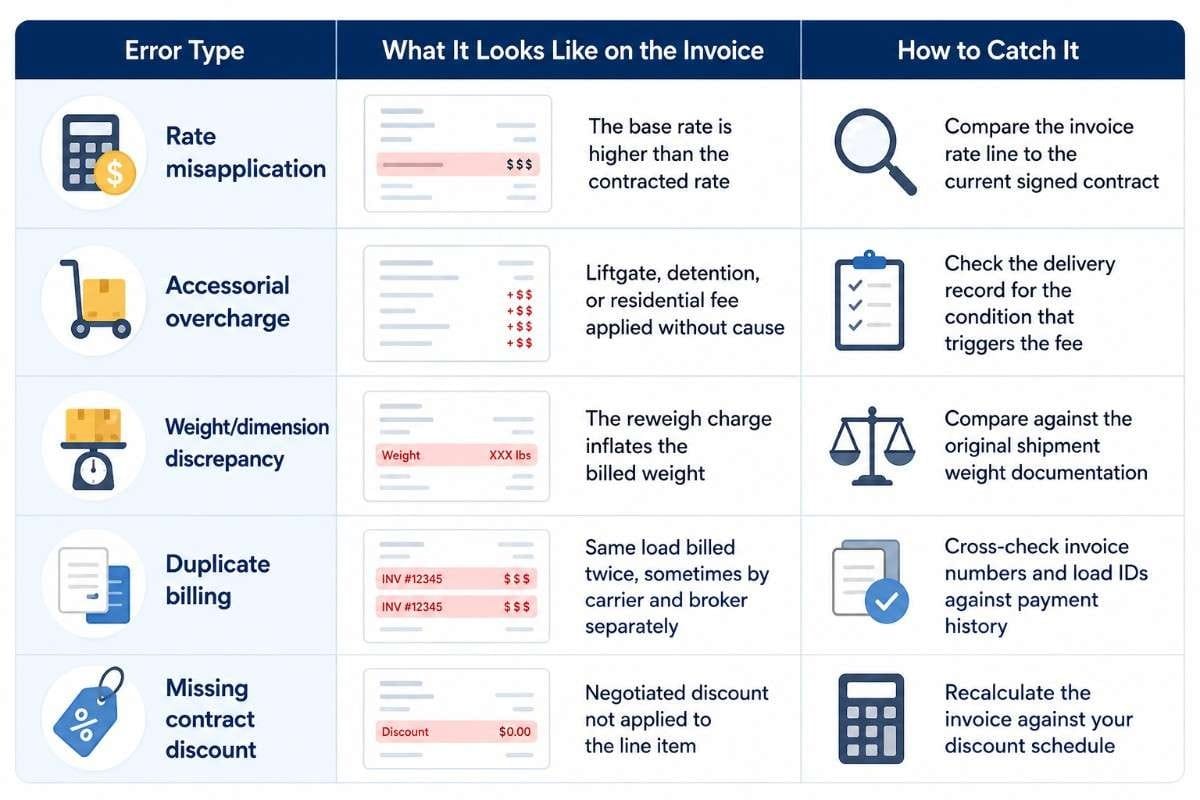
Before approving any freight invoice, check it against five recurring error categories rather than reading it line by line from scratch. This gets most of the recoverable value without requiring a full audit of every field on every invoice. Start with the base rate against your current contract, then move to accessorials, weight/dimension charges, duplicate billing, and applied discounts.
Businesses running this checklist manually can catch a meaningful share of errors, but volume is the limiting factor. Once invoice counts climb into the hundreds per month, manual line-by-line review becomes unsustainable, and this is where platforms built as a freight operating system, RoaDo among them, matter: automated invoice audit and reconciliation checks every invoice against contracted rates and shipment data before payment, rather than relying on a finance team to catch it after the fact.
Common Freight Billing Errors at a Glance
Freight Audit and the E-Way Bill Compliance Layer
In India, a freight audit needs to check more than cost accuracy; it needs to confirm that the invoice matches the e-way bill that accompanied the shipment. Every consignment above ₹50,000 in value requires a valid e-way bill, and that document must reflect the same invoice value, GSTIN, and goods description as the actual invoice.
An invoice-to-e-way-bill mismatch isn't just a bookkeeping issue; under CBIC's clarification, discrepancies here can be treated as an attempt to misrepresent the consignment, triggering detention and penalty proceedings under Section 129 of the CGST Act. A freight audit that only checks cost and ignores this cross-document consistency is missing a real compliance exposure; RoaDo’s direct GSTN portal integration addresses this by automatically flagging mismatches between invoices and e-way bills before payment.
How Can You Build a Freight Audit Process That Scales?
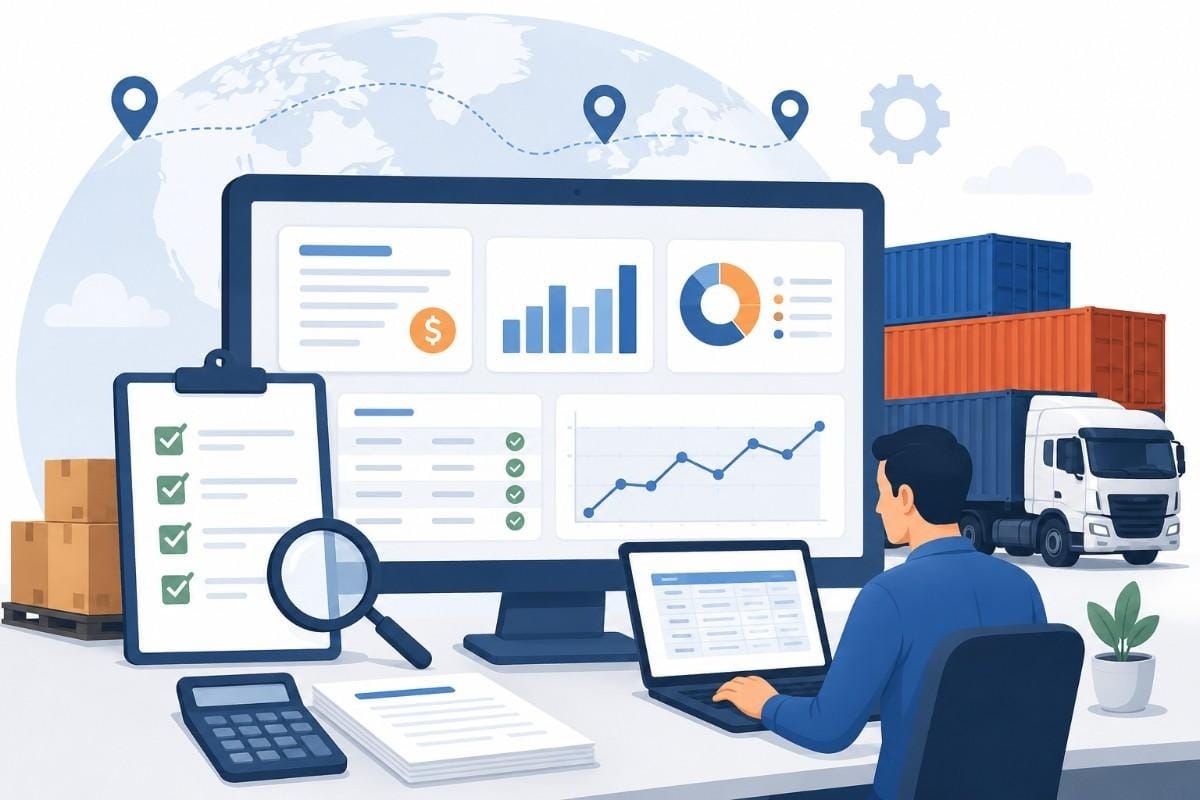
Below roughly 500 invoices a month, a disciplined manual checklist covering the error categories above will catch most of the recoverable value. Above that volume, the math changes. A typical freight audit program recovers 1% to 5% of total freight spend once it's running consistently, and LTL shipments specifically carry the highest variance, with weight and classification disputes producing 5-25% swings on individual invoices. At that scale, manual review simply can't keep pace with invoice volume, and errors compound month over month rather than getting caught.
This is the point where automation earns its cost. RoaDo's automated invoice audit and reconciliation capability has contributed to a 65% faster billing cycle and a 7-10 day reduction in days sales outstanding for the manufacturers and transporters it works with, not by replacing a finance team's judgment but by clearing the routine matching work so exceptions get human attention instead of every line item. Platforms like this are built for exactly this kind of recurring, high-volume reconciliation problem.
Frequently Asked Questions
1. What is a freight audit?
A freight audit is the process of checking freight invoices against contracted rates and shipment details to catch billing errors before payment.
2. How much money can a freight audit typically recover?
Systematic freight audit programs typically recover 1% to 5% of total freight spend once fully implemented.
3. What is the most common freight billing error?
Accessorial charge errors, such as liftgate or detention fees applied without the underlying condition occurring, are consistently the highest-error category.
4. What is the difference between a pre-audit and a post-audit?
A pre-audit catches errors before the invoice is paid, while a post-audit reviews invoices already paid and attempts to recover overcharges retroactively.
5. Do small businesses need a freight audit process?
Yes, even a simple manual checklist covering rate, accessorial, and weight discrepancies can catch meaningful overcharges for businesses with lower invoice volumes.
6. What is an accessorial charge in freight billing?
An accessorial charge is an add-on fee beyond the base freight rate, such as liftgate service, detention, or residential delivery.
7. Can e-way bill errors affect freight invoice accuracy?
Yes, a mismatch between an invoice and its corresponding e-way bill is treated as a compliance violation in India and can trigger penalties independent of any billing cost issue.
8. Should a freight audit be done in-house or outsourced?
For roughly 500 invoices per month, in-house manual review is generally sufficient, while higher volumes typically require automated audit tools or outsourced providers.
Conclusion
Freight invoice errors aren't rare exceptions; they're a structural feature of how carrier billing systems, contract updates, and manual data entry interact, and the evidence consistently shows a meaningful share of invoices carry some kind of overcharge.
A checklist-based audit covering rate accuracy, accessorials, weight discrepancies, duplicate billing, and discount application catches most of that recoverable value without requiring a complete process overhaul.
In India, that checklist has to extend one layer further, cross-checking invoice details against the e-way bill to avoid compliance exposure alongside cost exposure. As invoice volumes grow, the same logic that makes manual review unsustainable is what makes automated reconciliation worth the investment. Platforms like RoaDo are built for exactly this kind of recurring, high-volume audit problem, turning freight billing from a payment obligation into a controlled, checked process.
“Take control of freight billing with RoaDo's automated freight audit and reconciliation. Catch invoice errors, verify e-way bill compliance, and speed up payments with AI-powered logistics management. Contact RoaDo today.”