Route Optimization Software: A Complete Guide for Logistics Fleets

Key Highlights
- Fleets deploying route optimization software report an average 15% mileage reduction and 23% improvement in on-time delivery within 90 days.
- UPS's AI-powered ORION platform has cut 100 million miles driven annually, saving approximately ₹2,500-3,500 crore.
- Manually routed fleets average 72-78% on-time delivery, compared to 90-95% for optimized fleets.
- India's logistics cost stands at 7.97% of GDP, underscoring the scale of savings available from route-level efficiency.
Route optimization is the process of calculating the most efficient sequence and path for a fleet's stops, accounting for traffic, delivery windows, vehicle capacity, and driver constraints, rather than relying on a dispatcher's manual planning or fixed habitual routes.
It solves a specific, measurable problem: static, experience-based routing consistently adds unnecessary miles, and those miles cost fuel, time, and on-time performance at a scale most fleets underestimate until they measure it.
What Does Route Optimization Software Actually Solve for Fleets?

Route optimization exists to eliminate the gap between how a fleet is routed today and how it could be routed if every stop, constraint, and real-time condition were factored in mathematically.
For the average delivery or service fleet, 12 to 20 percent of total miles driven are avoidable, the direct result of static routing built on outdated assumptions and dispatch habits that favor familiarity over efficiency.
That gap compounds daily, which is why fleets that switch to optimized routing see savings show up within the first quarter rather than after a long ramp-up period.
The Core Benefits Behind the Numbers
The benefits of route optimization show up in three measurable places: fewer miles driven, higher on-time delivery rates, and better vehicle utilization. Fleets deploying route optimization software report an average 15% reduction in miles driven and a 23% improvement in on-time delivery within the first 90 days.
Manually routed fleets typically achieve only 72-78% on-time delivery and 65-75% vehicle utilization, compared to 90-95% on-time delivery and 85-92% utilization for optimized fleets, a gap that reflects poor stop sequencing and uneven driver workload rather than any difference in fleet size or vehicle quality.
"Empty miles" refers to the distance a vehicle travels without carrying revenue-generating cargo, most commonly on the return leg of a delivery run. Route optimization that considers both outbound and return trips helps reduce empty miles and improve fleet utilization.
Static vs Dynamic Route Optimization: What the Difference Actually Means
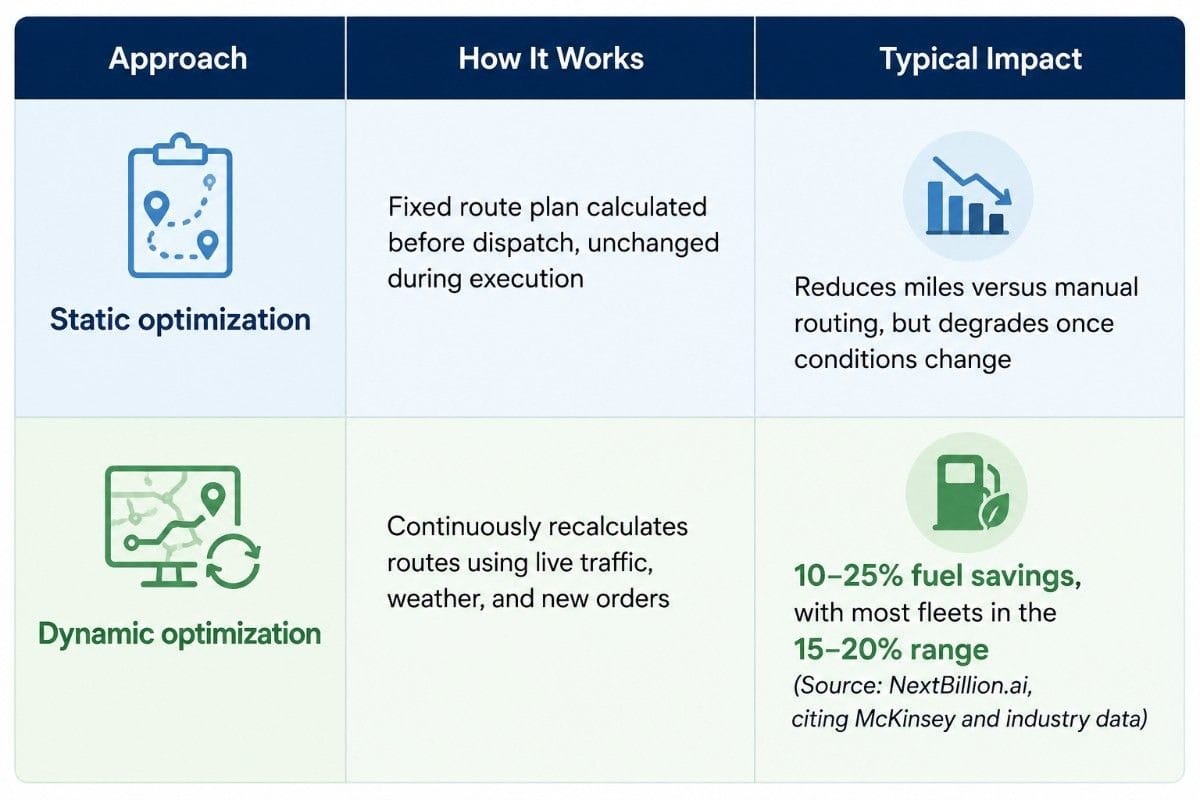
Static optimization calculates a fixed route plan before vehicles leave the depot and does not adjust once they're on the road; dynamic optimization continuously recalculates routes in response to live conditions.
once traffic, cancellations, or new orders change the picture. Dynamic, AI-driven optimization is what has powered the most cited large-scale example in the industry. UPS invested over approximately ₹8,500 crore to build its ORION platform, which has since reduced 100 million miles driven annually and saved the company approximately ₹2,500-3,500 crore.
A static route plan goes stale the moment real-world conditions diverge from what was assumed at planning time; dynamic optimization exists specifically to close that gap continuously rather than re-planning once a day.
Static vs Dynamic Route Optimization at a Glance
Why Does Route Optimization Matter More for Fragmented Indian Freight Networks?
Route optimization has an outsized impact in markets where freight networks are fragmented across many small carriers and third-party fleets, because inefficiency compounds across more independent decision points rather than being centrally planned. India's logistics cost was recently assessed at 7.97% of GDP, and a meaningful share of that cost sits in exactly the kind of route-level inefficiency, poor sequencing, uncoordinated dispatch, and unmanaged empty legs that optimization software targets directly.
Route optimization decisions are only as good as the visibility feeding them, though; a route plan built without knowing that a shipment is delayed or a vehicle's compliance document is about to expire produces a plan that breaks on execution. By integrating directly with VAHAN and GSTN, RoaDo automatically validates vehicle permits and e-way bill status before a route is even assigned.
This is where an end-to-end Freight Operating System (FOS) like RoaDo becomes relevant. not as the routing engine itself, but as the exception-management layer that flags delays and disruptions in real time, so dispatch decisions can be adjusted around accurate, current information rather than a morning plan that's already out of date.
Choosing and Implementing Route Optimization Software

Choose route optimization software based on how well it integrates with your existing dispatch and telematics systems, not on which platform has the longest feature list. Look specifically at whether the platform supports dynamic, real-time re-optimization. For fleets utilizing third-party carriers, RoaDo provides the necessary visibility layer through hardware-free tracking (SIM and browser-based), ensuring the routing engine receives real-time data without requiring GPS installation.
This real-time visibility is what allows for dynamic re-optimization rather than only static planning, which is the distinction that separates a 10-15% improvement from a 20%-plus one in practice. For fleets operating across a fragmented, multi-carrier network, pairing a dedicated route optimization tool with a visibility layer that surfaces exceptions, the kind of role RoaDo plays in tracking shipment and compliance status closes the gap between a route plan on paper and what actually happens on the road. Platforms like this are built for exactly that kind of real-time, exception-driven adjustment, working alongside a routing engine rather than replacing it.
Frequently Asked Questions
1. What is route optimization software?
Route optimization software calculates the most efficient sequence and path for a fleet's stops, factoring in traffic, delivery windows, and vehicle constraints.
2. How much can route optimization save on fuel costs?
Most fleets see fuel savings in the range of 10-25%, with typical results landing between 15 and 20%.
3. What is the difference between GPS tracking and route optimization?
GPS tracking shows where a vehicle currently is, while route optimization determines where it should go and in what order to minimize distance, time, and cost.
4. What is the difference between static and dynamic route optimization?
Static optimization creates a fixed plan before dispatch, while dynamic optimization continuously adjusts routes based on live traffic and operational changes.
5. How long does it take to see ROI from route optimization software?
Many fleets see measurable savings within 90 days of implementation, with full ROI often realized within 3-6 months.
6. Does route optimization work for small fleets?
Yes, route optimization scales from a handful of vehicles to large enterprise fleets, with cloud-based platforms enabling fast setup regardless of fleet size.
7. Can route optimization reduce empty miles?
Yes, optimization that accounts for both outbound and return legs can significantly reduce empty running by identifying backhaul and consolidation opportunities.
8. What data does route optimization software need to work?
It typically needs stop addresses, delivery time windows, vehicle capacity and constraints, and ideally real-time traffic and telematics data for dynamic adjustments.
Conclusion
Inefficient routing isn't a fixed cost of running a fleet; it's a measurable, recoverable gap that shows up in extra miles, missed delivery windows, and underused vehicles, and the data consistently shows optimized fleets closing that gap within their first quarter of use.
The clearest lesson from documented cases, from UPS's ORION platform down to mid-sized regional fleets, is that dynamic, real-time optimization consistently outperforms static, once-a-day planning by a wide margin. For fragmented freight networks like India's, where logistics costs remain a significant share of GDP, that gap represents real, recoverable money rather than a marginal efficiency gain.
Route optimization delivers the most value when it's paired with accurate, real-time visibility into what's actually happening on the road, since a route plan is only as good as the information behind it. As a modular Freight Operating System (FOS) , RoaDo supports that visibility layer, helping fleets achieve documented outcomes like a 65% faster billing cycle and significant reductions in empty miles, helping dispatch decisions stay grounded in current conditions rather than an outdated morning plan.
“Route optimization delivers the best results when paired with real-time visibility. With RoaDo, fleets can track shipments, manage exceptions, and make faster dispatch decisions to reduce delays and improve delivery performance.”