Fleet Management Software Features Checklist: What Indian Fleet Operators Need in 2026
Key Highlights
- Manual Logging Gap: 82% of Indian operators still rely on manual logs, leading to systemic misses in maintenance and compliance.
- ROI Potential: Comprehensive fleet software delivers an average 30% operational cost reduction.
- Mandatory Compliance: AIS-140 VLTD integration is the legal floor, with a shift toward GNSS tolling expected by 2026.
- Cloud Adoption: 70% of modern fleet instances are now cloud-based for seamless remote access.
The right fleet management software features depend on what you're actually trying to fix: fuel waste, compliance risk, maintenance downtime, or all three. Generic feature lists built for North American or European fleets often overlook many of the requirements that Indian operators need, as India imposes additional government compliance requirements, including AIS-140, VAHAN, e-way bills, and FASTag, on top of the standard.
GPS-tracking-and-maintenance feature set that most platforms are built around. This checklist separates the two: features every platform should have and features that are specifically non-negotiable for Indian fleets.
What Features Should Modern Fleet Management Software Actually Include?
Fleet management software features span four core categories: real-time vehicle tracking, maintenance and safety monitoring, fuel and cost control, and compliance and document management. Most global platforms are strong on the first two categories and weak or absent on the fourth, which serves as the litmus test for any software operating within the complex Indian regulatory ecosystem. Despite mature technology being widely available, 82% of fleet operators still rely on manual tracking, which shows up as missed maintenance intervals, fuel waste, and compliance gaps that a connected platform would catch automatically.
The Core Feature Categories Every Platform Should Have
Every fleet management platform, regardless of market, should combine live location tracking, driver behavior monitoring, maintenance scheduling, and fuel analytics into one connected system rather than separate tools. Driver behavior features tracking harsh braking, rapid acceleration, and speeding create objective performance data that supports coaching programs, and fleets using these programs alongside video telematics commonly see insurance premium discounts of 5-15%. Fuel monitoring is the other high-impact category; better visibility into consumption patterns, idling time, and route efficiency has been shown to reduce fuel costs by around 10% in optimized operations.
Telematics simply means the combination of GPS location data with vehicle sensor data, engine diagnostics, fuel level, and driver behavior, transmitted wirelessly to a central platform, rather than just a dot on a map.
Which India-Specific Features Are Non-Negotiable for Fleet Success?
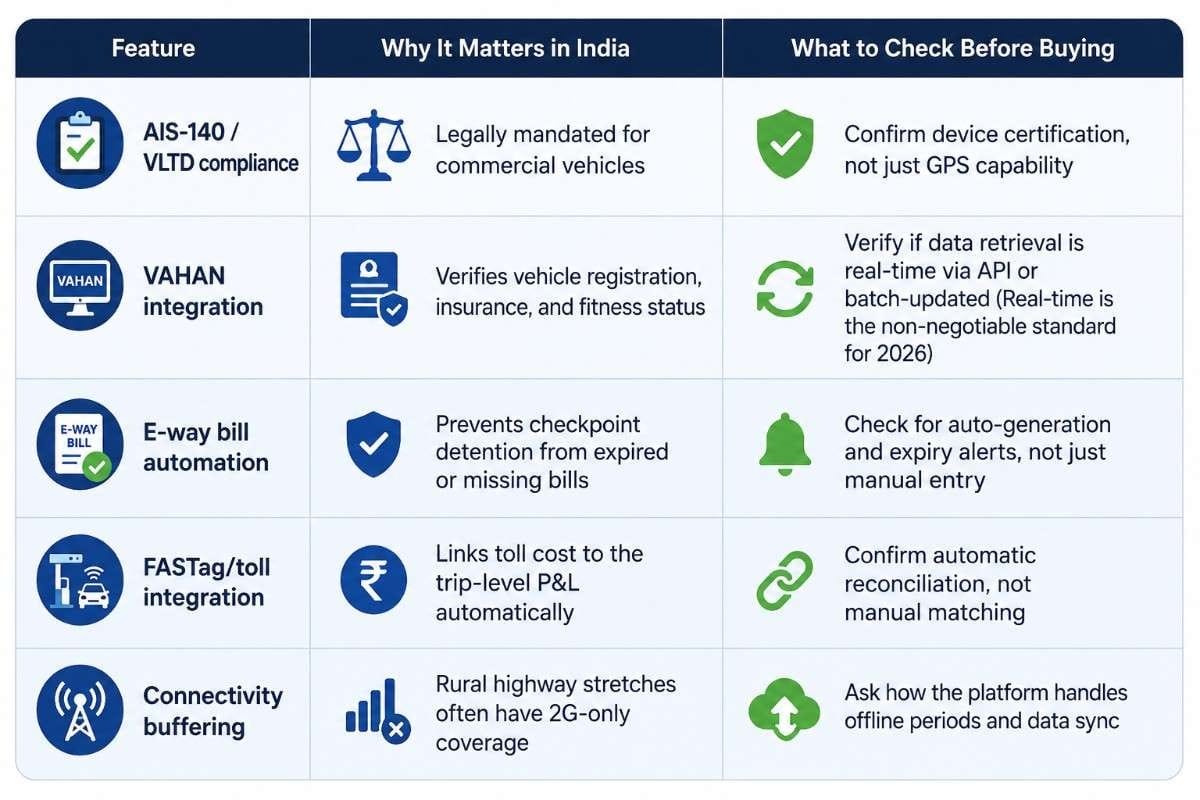
For Indian fleet operators, four features move from nice to have to mandatory: AIS-140 VLTD compliance, VAHAN integration, e-way bill automation, and connectivity handling for low-network highway stretches. Every commercial vehicle in India is now required to carry a certified vehicle location and tracking device compliant with the AIS-140 standard, with real-time GPS and integration into the government's VAHAN database. This is described as an enforcement floor by the Ministry of Road Transport and Highways, not a differentiator between vendors. Any platform evaluated without this baseline is not really a fit for Indian operations, regardless of how strong its other features are.
India-Specific Fleet Management Features at a Glance
Compliance Features That Prevent Checkpoint Delays and Penalties
Compliance features exist to stop a shipment from being physically detained, which is a different failure mode than a tracking gap or a missed maintenance window. Every consignment above the GST threshold requires a valid e-way bill, and Indian logistics compliance layers multiple additional documents on top of that: vehicle registration, insurance, fitness, and permits, each with its own expiry date that can trigger a checkpoint stop if missed. A checklist that only covers GPS and maintenance features without checking how the platform handles this document layer is missing the category of risk that actually stops trucks on the road.
Compliance features and tracking features solve different problems; tracking tells you where a vehicle is, while compliance features tell you whether that vehicle is legally allowed to be there, which is why a platform needs both, often from different sources.
This is where RoaDo differentiates itself: it acts as an intelligent compliance overlay that integrates with your existing GPS hardware to automate document auditing and e-way bill lifecycles. RoaDo's VAHAN and GSTN integration checks vehicle document validity and monitors e-way bill status automatically, without requiring any hardware installation, a distinct capability from AIS-140 tracking hardware, addressing the document-compliance side of the checklist rather than the vehicle-location side.
Evaluating Vendors: A Practical Checklist Before You Sign

Before signing with any fleet management vendor, separate your evaluation into hardware requirements, compliance coverage, and total cost of ownership rather than comparing feature lists side by side. Ask directly whether the platform is hardware-agnostic or requires proprietary devices, how it handles connectivity gaps on rural highway stretches, and whether e-way bill and AIS-140 compliance are built in or require a separate tool. For operations where document compliance and e-way bill monitoring are the priority pain point rather than hardware tracking, platforms like RoaDo can serve as the compliance-visibility layer alongside whatever GPS or telematics system already handles vehicle-level tracking. The two are complementary, not competing, purchases.
Frequently Asked Questions
1. What features should fleet management software have?
Core features include real-time GPS tracking, maintenance scheduling, fuel monitoring, driver behavior analytics, and compliance management.
2. Is AIS-140 mandatory for all commercial vehicles in India?
Yes, commercial vehicles in India are required to carry a certified AIS-140 vehicle location and tracking device integrated with the VAHAN database.
3. What is the difference between fleet tracking and fleet management software?
Fleet tracking focuses on GPS location and route monitoring, while fleet management software adds maintenance scheduling, compliance documentation, and cost analytics on top.
4. Do small fleet owners in India need fleet management software?
Yes, modular, scalable platforms now make core tracking and compliance features accessible even to operators running just a handful of trucks.
5. What is VAHAN integration in fleet management software?
VAHAN integration allows a platform to verify vehicle registration, insurance, and fitness status directly against India's national vehicle database.
6. Can fleet management software help with e-way bill compliance?
Yes, many platforms auto-generate e-way bills and send expiry alerts to prevent shipments from being detained at checkpoints.
7. How much does fleet management software typically cost?
Costs in India vary widely by fleet size and feature depth, ranging from a few thousand rupees per month for small fleets to several lakhs per month for enterprise deployments.
8. Should fleet management software be cloud-based or on-premise?
Cloud-based deployment is now the dominant model, powering roughly 70% of fleet software instances due to easier scalability and remote access.
Conclusion
Most fleet operators are still running significant parts of their operation manually despite mature software being available, and the gap is costing them in fuel waste, missed maintenance, and compliance exposure.
For Indian fleets specifically, the checklist has to go beyond generic GPS-and-maintenance feature lists to cover AIS-140 compliance, VAHAN integration, and e-way bill automation, since these aren't optional extras but the baseline for legally operating on Indian roads.
The most effective setups increasingly combine a hardware-based tracking platform for vehicle-level telematics with a compliance-focused layer for document and e-way bill monitoring, rather than expecting a single vendor to do both equally well. Platforms like RoaDo fill that second role, giving fleets automated visibility into vehicle documents and e-way bill status without requiring additional hardware. As compliance enforcement tightens further, the operators who treat tracking and compliance as connected, even when sourced from different vendors, will avoid the checkpoint delays that catch everyone else off guard.
“Stop letting paperwork stall your fleet. Schedule RoaDo a demo today to see how we automate your VAHAN and e-way bill compliance without requiring a single new piece of hardware.”