
Last-Mile Delivery Optimization in India: Strategies to Reduce Costs and Improve Delivery Efficiency
Key Highlights
- Last-mile delivery now accounts for roughly 53% of total shipping costs globally, up from 41% in 2018.
- In India's e-commerce logistics, last-mile costs make up about 60% of total shipment cost, with delivery agent manpower driving 80%.
- Urban congestion is raising per-stop delivery costs by up to 22% in metros like Delhi, Mumbai, and Bengaluru.
- Stop clustering and dynamic re-sequencing can reduce driven miles per delivery by 12-18%.
Last-mile delivery optimization is the process of reducing the time, distance, cost, and failure rate of the final delivery leg from a distribution point to the end customer's door. It's the most expensive and most customer-visible stretch of any supply chain, and in India specifically, it's also the stretch most exposed to urban congestion, address ambiguity, and manpower-driven cost structures. Getting it right isn't about adding more vehicles or drivers; it's about fixing the specific inefficiencies that make each delivery cost more than it should.
What Does Last-Mile Delivery Optimization Actually Target?
Last-mile delivery optimization targets four specific levers: route efficiency, first-attempt success rate, stop density, and delivery window accuracy. Each of these directly affects cost per delivery, which is why last-mile delivery optimization efforts succeed or fail based on whether they address the actual driver of cost, not just general "delivery speed." Globally, last-mile costs have climbed from 41% of total shipping costs in 2018 to roughly 53% today, meaning the leg logistics teams often treat as an afterthought is now the single largest cost line in most delivery operations.
Why Are Last-Mile Costs Climbing So Rapidly in India?
Last-mile costs in India are climbing because urban density, address inconsistency, and manpower dependency compound each other in ways that are hard to solve with scale alone. In India's e-commerce logistics specifically, last-mile costs represent roughly 60% of total shipment cost, and 80% of that last-mile cost comes directly from delivery agent manpower, fuel, time, and incentives paid to the person making the delivery. Layer on urban congestion and documentation delays, and the cost climbs further. RoaDo’s DPI integration with VAHAN and GSTN ensures mid-mile vehicles are compliant and move through checkpoints faster, protecting the inbound schedule last-mile teams depend on.
First-attempt success rate measures the share of deliveries completed on the first try, without a missed attempt or re-delivery. It matters because every failed attempt roughly doubles the manpower cost of that delivery.
Delivery Efficiency Strategies That Move the Needle
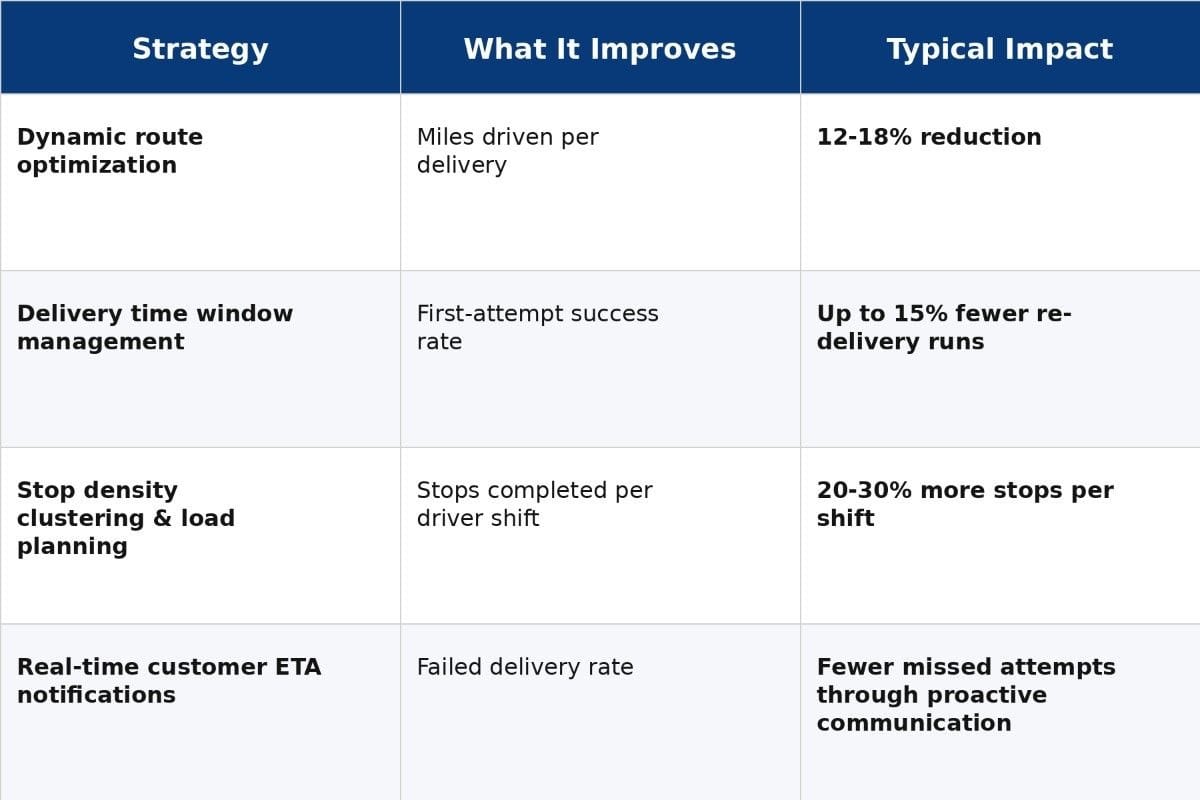
The strategies that actually reduce last-mile cost work at the route and load level, not the fleet-size level. Dynamic route optimization, re-sequencing stops based on real-time traffic and order changes rather than a fixed morning plan, reduces driven miles per delivery by 12-18% through better stop clustering alone. Delivery time window management, where customers get a precise arrival window instead of a day-long estimate, directly improves first-attempt success and reduces the cost of re-delivery runs by up to 15%. Better load and stop-density planning, grouping deliveries by geographic zone and sequencing by time constraint, can improve vehicle utilization by 20-30% more stops per delivery. per shift.
Last-Mile Delivery Optimization Strategies at a Glance
Does Last-Mile Efficiency Actually Start Before the Last Mile?
Last-mile performance depends heavily on whether goods arrive at the distribution hub or dispatch point on schedule in the first place. A delay in the mid-mile leg, from factory to hub, shows up downstream as a compressed or missed last-mile window. This is a distinct problem from last-mile route optimization itself, and it's where a platform like RoaDo fits, not as a last-mile delivery platform, but as the mid-mile visibility layer that uses hardware-free, SIM-based tracking to ensure inbound stock reaches the dispatch point reliably enough for last-mile teams to plan around it.
A delay in the mid-mile leg doesn't just push back one delivery; it compresses the entire day's last-mile schedule for every stop planned around that inbound shipment, which is why upstream reliability compounds into last-mile cost.
Building a Cost Reduction Plan Around Delivery Data
The most effective cost reduction plans start by measuring where the last-mile cost is actually concentrated, rather than applying a strategy uniformly. Track cost per delivery, first-attempt success rate, and stops per route before deciding whether the priority is route optimization, delivery window communication, or load planning. Each targets a different cost driver, and applying the wrong one wastes the investment. For manufacturers whose last-mile performance depends on predictable mid-mile arrivals, RoaDo's AI-based exception alerts, which have helped its customers avoid over 1 lakh delays in the industrial freight movements it tracks, reduce the upstream disruptions that would otherwise cascade into last-mile scheduling problems. Platforms like this address the reliability layer that last-mile optimization tools depend on, even though they operate in a different part of the supply chain.
Frequently Asked Questions
1. What is last-mile delivery optimization?
It's the process of reducing time, cost, distance, and failure rate in the final delivery leg from a distribution point to the end customer.
2. Why is last-mile delivery the most expensive part of logistics?
It's the most expensive because of high manpower dependency, low stop density per route, and urban congestion, which together drive up cost per delivery.
3. How can route optimization reduce last-mile delivery costs?
Dynamic route optimization reduces driven miles through better stop clustering and real-time resequencing, directly lowering fuel and time costs per delivery.
4. What is a good first-attempt delivery success rate?
While benchmarks vary by market, improving first-attempt success rate by even a few percentage points meaningfully reduces redelivery cost at scale.
5. Does last-mile delivery cost more in Indian cities than rural areas?
Yes, urban congestion in Indian metros has been shown to raise per-stop delivery costs by up to 22% compared to less congested areas.
6. How does delivery time window management reduce failed deliveries?
Giving customers a precise delivery window instead of a broad estimate reduces missed attempts because customers can plan to be available.
7. Can mid-mile delays affect last-mile delivery performance?
Yes, delays in the mid-mile leg from the factory to the distribution hub can compress or disrupt the entire last-mile delivery schedule planned around that inbound shipment.
8. What metrics should be tracked to measure last-mile delivery efficiency?
Cost per delivery, first-attempt success rate, on-time delivery rate, and stops per route are the core metrics to track.
Conclusion
Last-mile delivery optimization has become unavoidable, as this final leg now consumes over half of the total shipping cost, driven in India specifically by manpower dependency and worsening urban congestion.
The strategies that actually move cost, dynamic routing, delivery window management, and better load planning work at the route and stop level rather than requiring larger fleets, which makes them accessible to operations of most sizes. Last-mile performance doesn't start at the last mile, either; unreliable mid-mile arrivals compress the delivery windows that last-mile planning depends on, which means upstream visibility matters as much as downstream routing.
As delivery expectations continue to tighten, the operations that treat last-mile cost as a data problem, measured stop by stop, will outperform those still solving it with more vehicles. Platforms like RoaDo support this by keeping the mid-mile leg predictable, giving last-mile teams a stable foundation to plan against.
“Optimize your logistics with RoaDo's AI-powered logistics operating system. Gain real-time shipment visibility, reduce delays, and keep your last-mile operations running efficiently. Contact RoaDo today.”